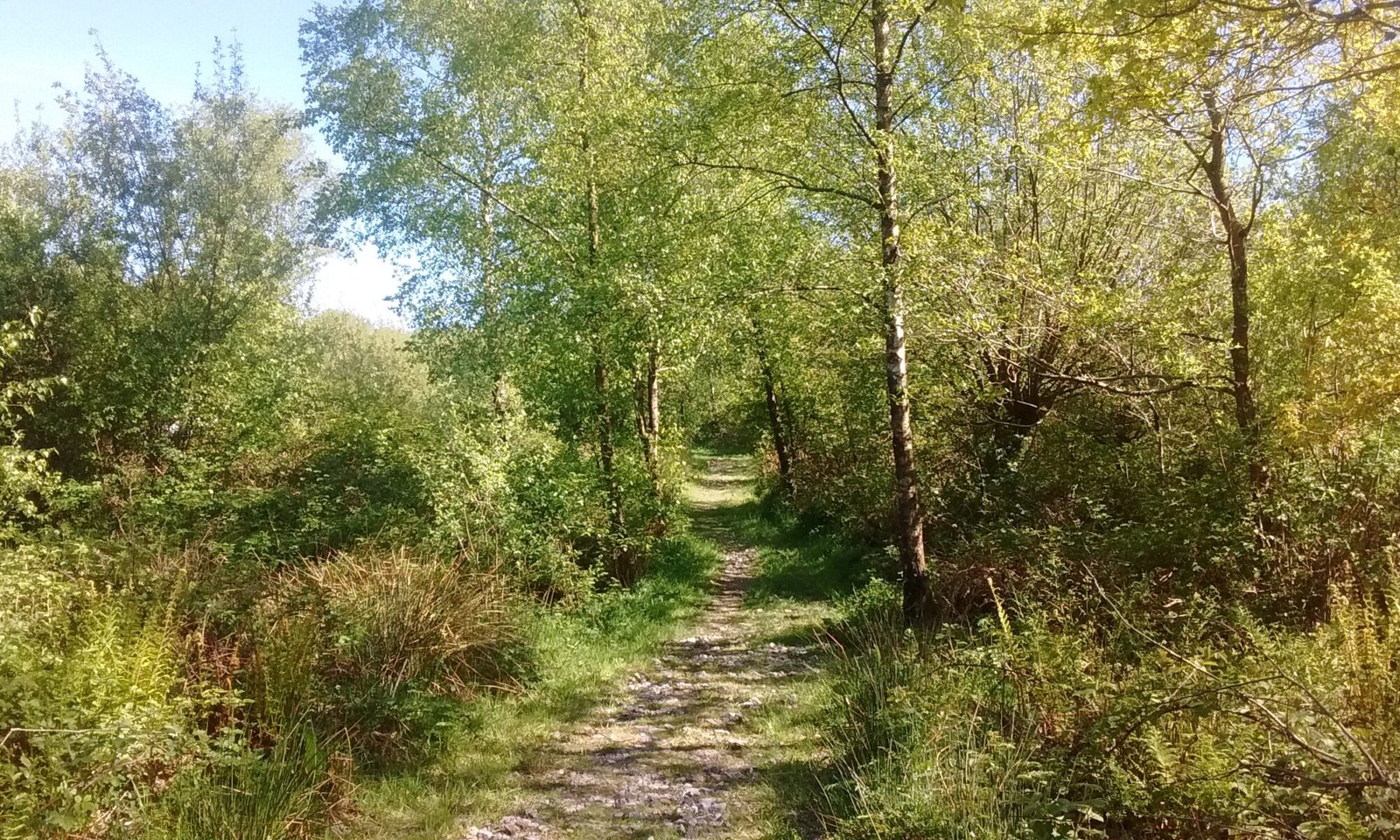

Our little patch of land is a mix of woodland and species rich grassland. To manage the species rich grassland we use a system we call “precision conservation grazing”. This is a form of mob grazing. The cattle are given a small areas of grazing and moved off when it has been grazed to the desired level to create good grassland habitat. We do this with electric fencing and in doing so we create a constantly changing landscape of electric fencing. This has resulted in a massive reduction in deer numbers. It is not that the deer are effectively excluded from any area of our land. The fences are low and they can easily jump them. We have created an area where the deer are likely to come across electric fencing and receive a shock. Because the electric fencing is constantly moving, they always have to be on the lookout for it when they’re on our land. This has made our land less attractive. We still get deer on our land, but we get a far fewer deer.

A year ago we took on the management of a woodland which has a high population of red and roe deer. It also has a restocking obligation. The previous owners clearfelled an area and failed to restock it as they were obliged to under the felling licence. They also failed to tell our clients about the restocking obligation when they sold it. By the time we were involved there was an enforcement notice from the Forestry Commission, requiring it to be planted asap.
Because of the high red deer presence, if we’d used tubes, they’d have had to be 1.8m tall. As well as being unsightly, tubes are an environmental disaster. There are biodegradable tubes, but all the trials we’ve seen have had mixed results at best. The restocking area is on a steep slope, so as well as being expensive, conventional fencing would be incredibly hard work to put up. Then, when it’s finished with it would have to be taken down, which is also hard work, especially if it’s covered in brambles.
2m Tall Electric Fencing
When we looked into electric fencing to exclude deer, first we came across 2m high electric fencing. This had 5 lines of electric wire. The lowest line is low enough that it needs vegetation to be controlled all through the growing season and its height means that it is almost as much grief to erect as a conventional fence. Where a high electric fence would work is if there was already a stock fence in place. You could attach batten to the fence posts and extend the fence upwards with electric lines. This would be a relatively quick and easy operation. Because the lower part of the fence was not electric, it wouldn’t need to be kept free of vegetation. Unfortunately the restocking area didn’t have an existing stock fence, so this wasn’t an option.
3D Electric Fencing
Then we came across 3D electric fencing. This works on the fact that, as deer have their eyes in the sides of their heads, they have no depth perception. If you place two fences a metre or so apart, they can’t judge how far away that second fence is. If they’ve learned that electric fencing hurts, they won’t risk taking the jump. This has been trialled in America on maize crops. The feedback is that the deer will break through the fence in two situations: if they are incredibly hungry, or they are chased by predators. The predator issue isn’t the same in the UK as it is in America and, certainly in Devon, there is no reason for a deer to be incredibly hungry.
Before we erected the 3D fencing, we put up a small section of fence across a deer track to train the deer in the same way you train livestock to an electric fence. They’re not in an enclosed area like livestock, so we put a bit of molasses on one of the fence posts to attract them in. Because it was only a short section, it had a real kick. We should have put a trailcam on it to see how they reacted, but time and funding didn’t allow for that. They certainly stopped using that track. When we were mapping out the extent of the 3d fence, we decided to stop just short of a well used deer track. It was on the edge of the restocking area anyway, so it seemed better to let them keep using it. To our surprise, they’ve abandoned it completely and created another track about 20m away. The 3D fencing hasn’t just protected the area inside the fence, it’s also dissuaded the deer from being in its proximity. There has been a notable drop in deer damage in the area of the woodland around the restocking area.
The Electric Snowflake
There has been no sign of any deer within the 3D fencing, but we’re aware that if a deer did get into the area, it could find itself trapped. We’ve designed the area with places where, hopefully, a deer could escape, but it would have to find these places. Our latest experiment avoids this problem. The “electric snowflake” as it was dubbed by a friend is not perimeter fencing. The idea of the electric snowflake is to have an energiser at the centre and electric lines going out from that point. This creates an area where deer are likely to come across the electric fence. The closer they are to the centre, the closer together the lines are and the more likely they are to run into them. Once they are within the area covered by the electric snowflake, the only clear line of sight with no visible electric tape is directly away from the energiser.
We’ve set up the electric snowflake in the same woodland as the 3d fencing. It’s actually only half a snowflake, due to the terrain making this the most suitable shape. The resident deer are already electric fence trained and the two fences will both reinforce that training. We’ve set it up next to a waterway where beavers are moving in. The owners are keen to encourage the beavers, so we’ll plant up willow and aspen as a food-source for them. We need to prevent the deer from eating the trees, without deterring the beavers, so we’ve gone for single lines of electric tape at 70cm high. Low enough that roe will come into contact with it, but high enough that beavers can walk around underneath. If a roe kid walks in, it won’t find itself trapped, so we don’t need a low line to prevent that. Where the tape meets the energiser, it’s attached by an S shaped wire, which will bend out of shape and release the tape if a deer runs through, or a tree drops on the tape. This prevents the tape from grounding out the energiser or lying on the ground where a beaver could come into contact with it whilst it’s live.
We’re consultants for the Woodland Trust and did an ancient woodland assessment for them in the woodland where it’s installed. They’ve sponsored the electric snowflake experiment, providing the fencing equipment and a trailcam to monitor it. We’re also planting two transects of willow, spaced at 2m spacing which go through the electric snowflake and another 400m downstream to monitor how it affects deer damage to highly palatable species.
Both the electric snowflake and the 3D fencing are experiments. We already have ideas on how we’d do them differently if we were starting again.
For a start, we wouldn’t buy an off-the-shelf solar energiser. Even though we’ve placed them both in the best position we could for sunlight, larger solar panels would be better. The electric snowflake has a larger energiser than it needs because it had a decent sized solar panel. We would make up a DIY energiser, with a large panel and a small 12v energiser for the electric snowflake and a larger version for the 3D fence.
We would have fewer lines on the electric snowflake. The current version is 22 lines. Probably 8 to 10 would be sufficient. You might want 16 lines for a larger area, to prevent the ends being too far apart. It will be interesting to experiment with different configurations.
We’d use better fencing tape. We didn’t realise how much difference there was with the conductivity of different tapes. The better tape is a lot more expensive, but we think it would be worthwhile, especially on the 3D fence, which has a long distance between the energiser and the furthest point of the fence. As a cost saving measure, expensive tape could be used for the top line and the other lines could be attached to that at various points.
We would be quite fussy about what sites we put 3D fencing on. On a flat field, with no brambles, where we could walk around the perimeter once a month with a strimmer, that would be ideal. At the time of writing this, we’re starting the first summer of it being in place. We can see the brambles being a real issue.
It would be interesting to try using wire rather than tape, or as well as tape. As the wire is less visible than tape, the deer would be more likely to come into contact with it. As a result it might make them give it a wider berth. One option would be to extend the tape out with wire. They would learn to avoid the visible tape, but also learn that there was a less visible element as well, which was harder to judge.